Coastal guide
Garage Storage Systems for Coastal Homes: Fighting Humidity and Salt Air
Garages within a couple of miles of the San Diego coast take a different kind of beating than garages further inland. It's not just humidity — it's salt-laden air working its way into metal fasteners, hinges, and shelving hardware, often invisibly at first, until a bracket that looked fine last year starts showing rust streaks or a cabinet door starts sticking. If your garage storage is a few years old and starting to show it, you're not imagining things, and there's a real difference between storage built for a coastal garage and storage that just happens to be sitting in one.
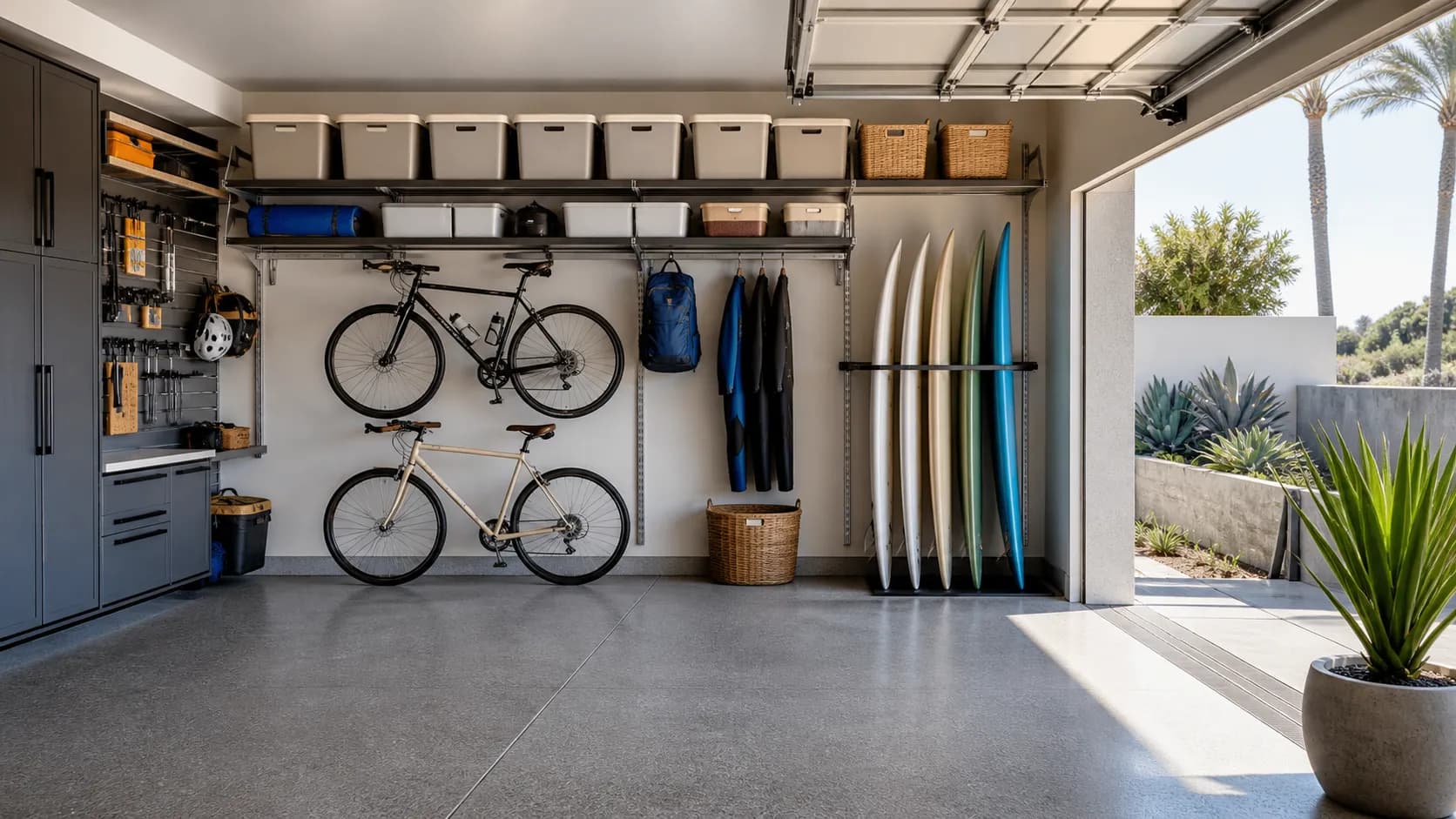
Garages within a couple of miles of the San Diego coast take a different kind of beating than garages further inland. It's not just humidity — it's salt-laden air working its way into metal fasteners, hinges, and shelving hardware, often invisibly at first, until a bracket that looked fine last year starts showing rust streaks or a cabinet door starts sticking. If your garage storage is a few years old and starting to show it, you're not imagining things, and there's a real difference between storage built for a coastal garage and storage that just happens to be sitting in one.
Why Coastal Garages Fail Faster
Standard steel shelving brackets, cheap drawer slides, and uncoated fasteners are usually rated and tested for general indoor use, not for an environment where salt air enters every time the garage door opens. Add San Diego's marine-layer humidity, and you get a slow, steady corrosion process that's easy to miss until it's already affected structural hardware, not just cosmetic finish. Garages that also store bikes, beach gear, and outdoor equipment compound the problem, since that gear tracks in sand and moisture on top of what's already coming through the air.
Self-Test: Is Your Garage Storage Losing the Fight?
Do you see rust spots on shelf brackets, hooks, or hardware, even if the shelving itself still looks fine? That's usually the earliest sign, and it's worth addressing before it spreads to load-bearing hardware.
Are drawers or cabinet doors sticking or harder to open than they used to be? Swelling from humidity or corroding slides are both common coastal-specific causes.
Is your shelving made from uncoated steel or basic particleboard? Both are more vulnerable to this environment than coated steel, solid wood treated for moisture, or slatwall systems designed for it.
How close is your home to the water, and how often is your garage door open to outside air? Proximity and airflow both increase exposure, which is worth factoring into how much you invest in corrosion-resistant materials.
Material Options Compared
| Material / System | Moisture & Salt Resistance | Best For |
|---|---|---|
| Uncoated steel wire shelving | Lower — prone to rust over time near the coast | Inland garages, short-term or budget storage |
| Powder-coated steel shelving | Higher — coating resists corrosion significantly better | Most coastal garages, general storage |
| Solid wood (properly sealed) | Moderate to high, depends on sealing and maintenance | Custom builds, finished-look garages |
| Slatwall panel systems | Higher — panel and accessory hardware options vary in coating quality | Organized tool, gear, and equipment storage |
| Stainless or coated fasteners throughout | Highest | Any system in a directly coastal-exposed garage |
Common Garage Layouts We See in San Diego County
Garages in San Diego County's coastal neighborhoods come in a few recurring shapes, and each one changes what a good storage plan looks like. A standard single- or two-car garage used primarily for parking usually benefits most from overhead and wall-mounted storage that keeps the floor clear for vehicles. A garage that's been informally converted into a workshop, gym, or storage-only space — common in denser coastal neighborhoods where indoor square footage is limited — often needs a more built-out system with dedicated zones for different categories of gear rather than a few generic shelves. And a garage shared between vehicle parking and heavy recreational-gear storage (surfboards, bikes, beach equipment) typically does best with a mix of overhead racks for infrequently used items and easily accessible wall-mounted hooks or shelving for gear that comes in and out weekly. Telling us which of these best describes your garage during the estimate helps us recommend a layout that actually matches how you use the space, rather than a one-size solution.
Layout Considerations for San Diego Garages
Beyond material choice, layout matters. Overhead storage keeps rarely used items off the floor and out of the splash zone if water ever gets in during heavy rain. Wall-mounted systems that keep gear off a concrete slab reduce moisture contact for anything stored near ground level. And leaving airflow space behind shelving units, rather than mounting flush against a damp exterior-facing wall, gives moisture somewhere to go instead of trapping it against your storage.
Seasonal Maintenance for Coastal Garage Storage
Even the right materials benefit from a little seasonal attention in a coastal environment. A quick rinse or wipe-down of shelving and hardware every few months helps clear accumulated salt residue before it has a chance to sit against metal long-term, especially after a stretch of onshore winds or a rainy period followed by dry heat. It's also worth checking that any garage door seals are intact, since a gap that lets in wind-driven moisture during a storm undoes a lot of the benefit of coastal-rated shelving. None of this is complicated, but it's the kind of five-minute habit that meaningfully extends the life of whatever system you invest in.
What the Installation Process Looks Like
We start by assessing your garage's exposure, existing wall condition, and what you actually need to store — walking through what currently lives in the space, what's overflowing onto the floor, and what you'd add if there were room for it — then recommend materials and a layout suited to both your space and your proximity to the coast. Installation includes proper wall anchoring (accounting for stud spacing and wall type), assembly of shelving, cabinet, or slatwall systems, and a walkthrough to confirm everything is level, secure, and organized the way you actually use the space. For larger projects — a full garage reorganization rather than a single shelving unit — we typically sequence the work so you're not without garage access for longer than necessary, and we haul away packaging and offcuts as part of the job.
Frequently Asked Questions
How often should I inspect garage hardware for corrosion in a coastal home? A quick visual check every few months is a reasonable habit, especially for homes within a mile or two of the water.
Is powder-coated steel worth the difference over standard steel? In most coastal San Diego garages, yes — the added corrosion resistance tends to extend the useful life of the system meaningfully.
Can you retrofit an existing garage or does it need to be a full teardown? Most projects are retrofits — we work with your existing space rather than requiring a full teardown unless the current setup is structurally compromised.
Do you install overhead storage as well as wall shelving? Yes, as part of a full garage storage layout.
Do you serve inland San Diego County garages too, or only coastal ones? Both — the coastal-specific material guidance matters most within the first couple of miles of the water, but we install garage storage systems throughout San Diego County.
Related Reading & Get an Estimate
See our Assembly & Installation service page for the full range of storage work we do, or check the neighborhood page for your area. Ready to fix a garage that's losing the fight against the coast? Call (619) 845-4291, email hello@coastalavhome.com, or request a free estimate online.
Ready for a plan?
Bring the room, wall, and equipment into one conversation.
Tell us what you are installing, where it is going, and what timing you have in mind.