Coastal guide
Murphy Bed vs. Built-In Wall Bed: Which Fits a Coronado Condo?
Coronado condos rarely have a spare bedroom to burn on a bed that only earns its square footage when guests visit. That's the exact problem both Murphy beds and built-in wall beds solve, and it's why the choice between them comes up so often on the island. Neither option is universally better — the right one depends on your room, your building, and how you actually plan to use the space.
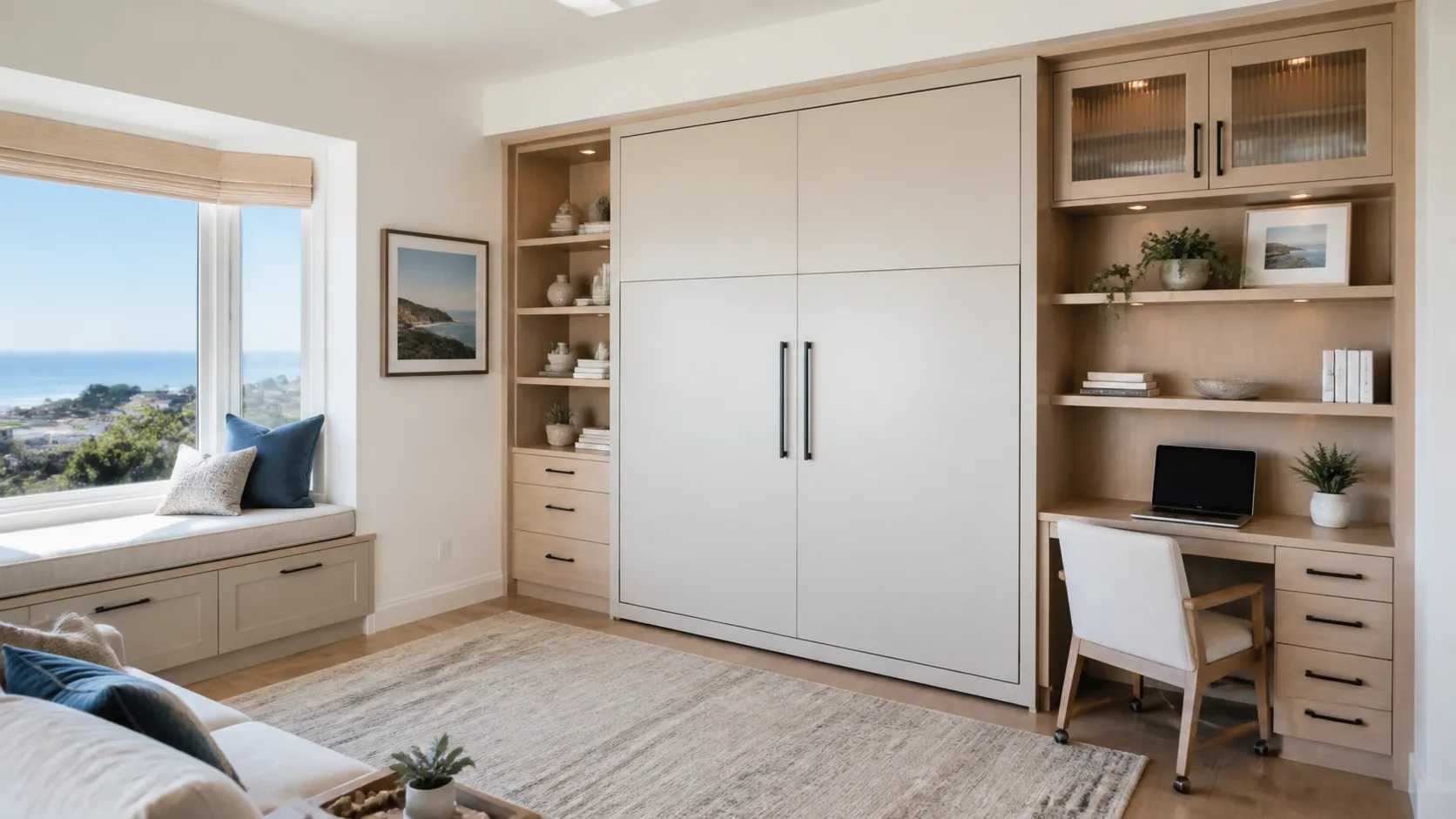
Coronado condos rarely have a spare bedroom to burn on a bed that only earns its square footage when guests visit. That's the exact problem both Murphy beds and built-in wall beds solve, and it's why the choice between them comes up so often on the island. Neither option is universally better — the right one depends on your room, your building, and how you actually plan to use the space.
The Core Tradeoff
A Murphy bed is a self-contained unit — a bed frame and mattress that folds up into a cabinet, sold as a manufactured piece that gets installed into your room rather than built around it. A built-in wall bed is custom-built to your specific wall and room dimensions, typically integrated with surrounding cabinetry, shelving, or a desk that shares the same footprint. The core tradeoff is standardization versus customization: a Murphy bed is faster to source and install and easier to take with you if you move; a built-in is designed around your exact space and can double as storage, a home office, or both when the bed is folded away.
Self-Test: Which One Fits Your Condo?
Do you own or rent, and how long do you plan to stay? A built-in wall bed is a fixture that adds value to a home you own long-term, but it's a poor fit for a rental or a condo you expect to sell or leave within a couple of years — you can't take it with you the way you can a Murphy bed unit.
Do you need the space to do double duty as an office, guest room, and everyday living space, all in the same footprint? Built-ins are generally better at integrating a desk, shelving, and the bed into one continuous design. A Murphy bed alone typically needs separate furniture nearby for those other functions.
What's your wall and room geometry? Built-ins require enough flat wall space and depth for custom cabinetry, and they're harder to reconfigure later. A Murphy bed unit has more flexibility in exactly where it sits, which matters in an oddly shaped Coronado condo room.
Do you want something installed quickly, or are you fine with a longer design-and-build timeline? A Murphy bed unit is typically a shorter project from order to installed; a built-in involves more design and lead time up front.
Side-by-Side Comparison
| Factor | Murphy Bed | Built-In Wall Bed |
|---|---|---|
| Customization | Standard sizes and finishes | Fully custom to your room |
| Portability | Can be uninstalled and moved | Fixed to the property |
| Integration with storage/desk | Limited without separate furniture | Can be designed as one system |
| Typical timeline | Shorter, order-to-install | Longer, design-and-build |
| Best for | Renters, owners planning to move, simpler rooms | Long-term owners, multi-use rooms, odd layouts |
Factors That Affect Project Scope
Beyond the core Murphy-bed-versus-built-in decision, a few specifics shape how big either project actually is. Room dimensions and wall geometry determine how much design flexibility you have, especially for a built-in that needs to fit an exact footprint. The level of customization you want — a simple Murphy bed cabinet versus one integrated with matching shelving, or a built-in with just a bed versus one that also includes a fold-down desk — changes both the design conversation and the installation itself. Existing wall construction matters for anchoring either option securely, and if you're integrating the bed with other built-in cabinetry already in the room, coordinating the finish and fit with that existing work adds a design step that a standalone installation wouldn't need.
HOA and Building Considerations in Coronado
Many Coronado condo buildings have HOA guidelines that touch on structural or wall-mounted alterations, and a built-in wall bed is more likely to fall under those rules than a Murphy bed unit, which is generally treated as furniture rather than a fixture. Before committing to either option, it's worth checking your building's rules and, if you're a renter, your lease terms — a built-in in particular is a change your landlord or association will want to know about in advance.
Maintenance and Longevity
Both options are built to handle daily folding and unfolding for years when installed correctly, but they age differently. A Murphy bed's mechanism is a manufactured, standardized part — if a hinge or piston ever needs service, replacement parts are generally easier to source since the unit is a known, mass-produced product. A built-in wall bed's mechanism is usually integrated into custom cabinetry, which means repairs may take more coordination but the surrounding cabinetry itself, being custom-built, tends to hold up well and can be refinished or repainted over time without replacing the whole system. In either case, the most common longevity issue we see isn't the mechanism — it's inadequate wall anchoring at installation, which is why we treat that step as non-negotiable regardless of which option you choose.
Design and Finish Options
Murphy bed units typically come in a set range of finishes and cabinet styles from the manufacturer, which keeps costs and lead times predictable but limits how much you can customize the look. A built-in wall bed can be finished to match existing trim, cabinetry, or a specific design vision for the room, and can incorporate integrated lighting, bookshelves, or a fold-down desk in ways a standalone Murphy bed unit generally can't. If matching your unit's existing built-in cabinetry or achieving a very specific look matters more than speed or portability, that tips the decision further toward a built-in.
What the Installation Process Looks Like
For a Murphy bed, we assess the room, confirm wall type and anchoring points, and install the unit level and securely fastened, checking clearance for the bed to fold up and down without hitting nearby furniture or fixtures. For a built-in wall bed, the process starts with a design conversation about your room's dimensions and how you want the finished cabinetry to function, followed by custom construction and installation, with the same attention to secure anchoring given how much weight and daily use the mechanism sees. In both cases, we test the fold mechanism multiple times before considering the job complete, and walk through proper operation with you so the bed continues to perform the way it did on day one.
Frequently Asked Questions
Which one is better for a rental unit? A Murphy bed, in almost every case, since a built-in becomes part of the property and isn't yours to take when you move.
Can a built-in wall bed also include a desk or shelving? Yes — that's one of the main advantages of a built-in over a standalone Murphy bed unit.
Do Murphy beds feel less sturdy than a built-in? A properly installed Murphy bed, anchored correctly to the wall studs or appropriate blocking, is a stable, durable piece of furniture; the mechanism is designed for daily folding use.
Will my HOA need to approve a built-in wall bed? Possibly — check your building's guidelines before starting the project, since rules vary by building.
Do you install both options in Coronado? Yes, along with the rest of our San Diego County service area.
Related Reading & Get an Estimate
See our Coronado neighborhood page for more on installation work on the island, or our Assembly & Installation service page for the full range of furniture and built-in work we handle. Ready to talk through your room? Call (619) 845-4291, email hello@coastalavhome.com, or request a free estimate online.
Ready for a plan?
Bring the room, wall, and equipment into one conversation.
Tell us what you are installing, where it is going, and what timing you have in mind.