Coastal guide
Can You Mount a TV Above a Fireplace in a Del Mar or La Jolla Home?
Yes — in most Del Mar and La Jolla homes, you can mount a TV above a fireplace, and it's one of the most common requests we get in both neighborhoods. But "can you" and "should you" are different questions, and the answer to the second one depends on your specific fireplace, room layout, and how you actually watch TV. This guide walks through both.
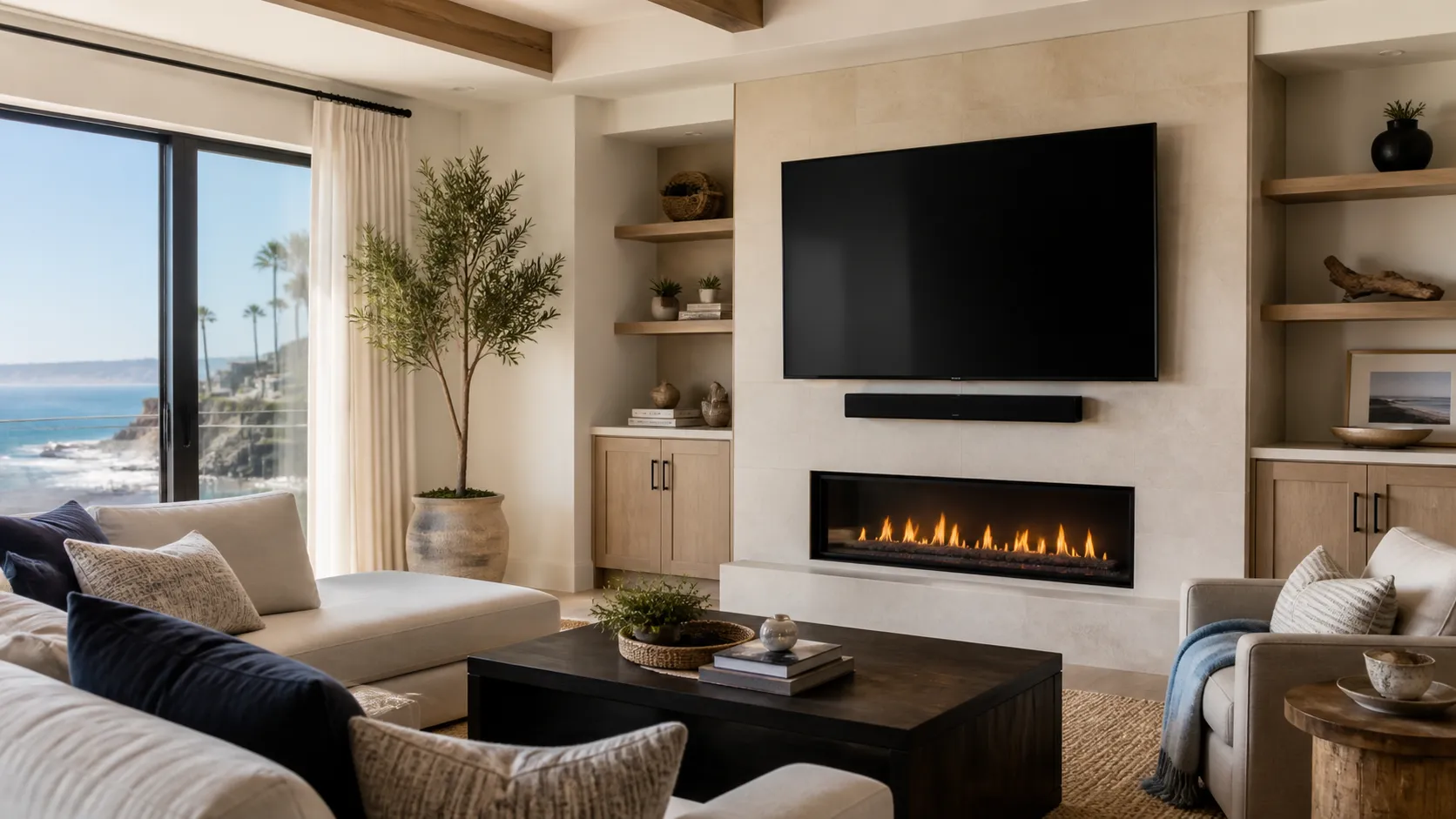
Yes — in most Del Mar and La Jolla homes, you can mount a TV above a fireplace, and it's one of the most common requests we get in both neighborhoods. But "can you" and "should you" are different questions, and the answer to the second one depends on your specific fireplace, room layout, and how you actually watch TV. This guide walks through both.
The Short Answer
Above-fireplace mounting works well when the fireplace surround doesn't get hot enough to stress modern television electronics, when the viewing height doesn't force you to crane your neck from the seating area, and when there's a realistic way to run or conceal cable to the mount. All three of those are solvable in the large majority of Del Mar and La Jolla living rooms we've evaluated, but not every fireplace is a good candidate, and it's worth checking before you commit to the look.
Self-Test: Is Your Fireplace a Good Candidate?
Ask yourself four questions before deciding:
Does your fireplace run gas or wood, and how hot does the mantel and surround get during normal use? A gas fireplace with a well-insulated firebox and a masonry or stone surround usually stays cool enough at TV height, especially in homes with taller ceilings common in Del Mar's newer construction. A wood-burning fireplace that runs hot for hours generates more radiant heat that a mounted TV has to tolerate over years of use, not just one evening.
How tall is your ceiling, and how far back is your seating? The taller the space above the mantel, the higher the TV center sits above eye level when you're seated — and the more your neck has to tilt to watch comfortably. A full-motion or tilting mount can offset some of this, but there's a point (roughly when the screen center sits much more than 15–20 degrees above seated eye level) where no mount fully solves it.
What's behind the wall above your fireplace? Masonry, stone veneer, and some fireplace surrounds are solid or nearly solid, which changes how — or whether — cable can be run inside the wall versus needing a surface-mounted raceway.
Do you actually watch TV from a spot facing the fireplace, or is the room's real seating arrangement angled elsewhere? This sounds obvious, but it's the single most common thing homeowners realize only after the TV is up.
The Real Risks — Heat, Viewing Angle, and Cable Management
Heat is the most talked-about risk and the most manageable one. Modern flat-panel TVs run cooler than older plasma displays, and a few inches of clearance plus normal home ventilation is usually enough for a gas fireplace. The bigger, more common issue is viewing angle: a TV mounted too high for the room's ceiling height turns even good content into a neck-strain exercise, especially for anyone watching for more than twenty or thirty minutes at a stretch. Cable management is the third piece, and it's where a professional installation earns its keep — a visible cord running down a fireplace surround undermines the clean look that's usually the whole point of mounting above the fireplace in the first place.
Mounting Options Compared
| Mount Type | Best For | Tradeoff |
|---|---|---|
| Fixed (flush) mount | Rooms where seating directly faces the fireplace at a comfortable height | No angle adjustment after installation |
| Tilting mount | Taller ceilings, mantels higher than ideal eye level | Only adjusts up/down tilt, not side-to-side |
| Full-motion (articulating) mount | Rooms with seating at an angle, or multi-use rooms | Most adjustable, but needs more wall clearance and stronger anchoring |
| Recessed / in-wall mount | Homes wanting a fully flush, cable-free look | Requires wall construction that allows a recessed box; not viable on solid masonry |
Factors That Affect Project Scope
A handful of things determine how involved an above-fireplace mounting project actually is, and it's worth knowing them before you get an estimate. Wall material is the biggest factor — mounting into a solid masonry or stone surround generally takes more time and different hardware than mounting into drywall over standard framing. Cable routing distance matters too: a straightforward run from the mount down to a nearby outlet or media cabinet is quicker than routing cable a longer distance to reach equipment in another part of the room. Whether your existing electrical setup already has an outlet near the mounting point, or needs one added by a licensed electrician, is another variable — we'll flag this during the estimate rather than assuming it either way. Finally, mount type plays a role: a fixed mount is the simplest installation, while a full-motion mount with more moving parts and heavier-duty anchoring takes more time to install correctly.
Why Coastal Homes Need a Different Approach to Hardware
Del Mar and La Jolla homes close to the water deal with salt-laden air that accelerates corrosion on standard mounting hardware faster than it would ten or more miles inland. This matters most for any exterior or garage-adjacent installation, but even indoor hardware in homes with a lot of ocean-facing glass and airflow benefits from corrosion-aware fasteners and mount selection. It's a small detail, but it's the difference between hardware that looks and performs the same in five years and hardware that starts showing rust streaks down a fireplace surround.
If Your Fireplace Isn't a Good Candidate
Not every fireplace wall is the right answer, and it's worth saying plainly: if your self-test above turned up a ceiling height that pushes the screen well above comfortable eye level, or a wood-burning fireplace that runs genuinely hot for hours at a time, above-the-fireplace mounting may not be the best long-term choice even though it can technically be done. In those cases, the more common alternatives are a wall mount to the side of the fireplace at proper eye height, a freestanding media console with the TV on a lower credenza-height mount, or — for a media-room-specific space rather than the main living room — moving the primary viewing setup to a wall without a fireplace at all. We'll walk through these options honestly during the estimate rather than defaulting to the above-the-mantel look just because it's the most requested one.
What the Installation Process Looks Like
We start by identifying what's actually behind the wall — masonry, stone veneer, drywall over furring strips, or something else — since that determines both the anchoring approach and whether cable can run inside the wall or needs a surface-mounted cable channel. We measure seating distance and height to recommend a mount type and TV center height suited to your specific room, not a generic "eye level" rule of thumb. From there, we handle the physical anchoring — which on a masonry or stone surround typically means specialized fasteners rated for that material rather than standard drywall anchors — then run or conceal cable using the approach that fits your wall, mount the television, and connect and test your equipment. Before we call the job finished, we walk through the result with you and adjust angle or height on the spot if anything's off from how you actually sit and watch, since a showroom-perfect mount that doesn't match your actual viewing habits isn't a finished job in our book.
Frequently Asked Questions
Is it safe to mount a TV above a gas fireplace? In most cases yes, especially with normal clearance and a well-functioning firebox, but we assess your specific fireplace during the estimate rather than assuming.
Will heat damage my TV over time? Modern TVs are more heat-tolerant than older models, and proper clearance plus your home's normal ventilation is usually enough; we'll flag it if your setup looks like an exception.
Can you hide the cables completely? Often yes, depending on what's behind the wall; we'll explain your specific options rather than promising a result before we've seen the wall.
What if my ceiling is too tall for comfortable viewing? A tilting or full-motion mount can help, but for some rooms we'll tell you honestly that a lower mounting point elsewhere might serve you better than forcing it above the fireplace.
Do you serve both Del Mar and La Jolla for this kind of installation? Yes, along with the rest of our San Diego County service area.
Related Reading & Get an Estimate
See our Del Mar and La Jolla neighborhood pages for more on installation work in each area, or our Home Theater & AV service page for the full range of what we install. Ready to talk about your fireplace and room? Call (619) 845-4291, email hello@coastalavhome.com, or request a free estimate online.
Ready for a plan?
Bring the room, wall, and equipment into one conversation.
Tell us what you are installing, where it is going, and what timing you have in mind.